global traveler, Writer & community builder on a mission to awaken the world. join the adventure.
Whispers of the Mala: Significance of the Conch in Buddhist Symbology
Explore the spiritual and symbolic significance of the Conch Shell (shankha) in Buddhist practice. Through personal experience and historical context, learn how conch shell malas are used for prayer and meditation, their representation in Buddhist art and rituals, and their role as one of Buddhism’s Eight Auspicious Symbols (ashtamangala).
SACRED SITES & TEACHINGSNEPALBUDDHISM
Xtinna
1/13/20262 min read


After visiting several Buddhist monasteries on my recent travels in three different Asian countries, I decided it's finally time to get some malas, the beads used for prayers and mantras.
You don't have to become a Buddhist (or Hindu) to get yourself a set of malas. They can be used as a meditation tool by anyone who wants to practice with them.
Deciding on one was difficult; so many options were available—different crystals, various types of wood, and more. Inspiration struck while in Nepal at Kopan Monastery, where their beautiful selection encouraged me to choose.
From over 20 types of malas, I narrowed my search down to three. Then, one by one, carefully felt into each mala's energy. Ultimately, I selected a striking white set made of conch shell. When I held them, I felt very peaceful and at ease. So I knew these were the ones for me!
Conch Shells in Buddhist Art and Malas
I noticed that the conch-shell motif frequently appears in Buddhist art and statues. Depictions of it appear in the hands of the Buddha and various deities. It also finds its way into temple architecture and thangka paintings—traditional Tibetan Buddhist artworks, typically made on cotton or silk, that portray deities, mandalas, or religious scenes for meditation and teaching.
I later learned that, when used in malas, conch shell beads represent purity, clarity, truth, and spiritual awakening. They also represent fearlessly speaking your truth.
Some believe that malas made from conch shells can amplify the power of mantras, helping anyone who uses them to connect more deeply with their intentions.
Interesting Fact: Traditional malas always have 108 beads, a sacred number. Read 'The Power of 108: Embracing a Sacred Number".
The Significance of Conch Shells in Buddhism
Conch shells, called “shankha” in Sanskrit, are important in Buddhist symbolism and rituals.
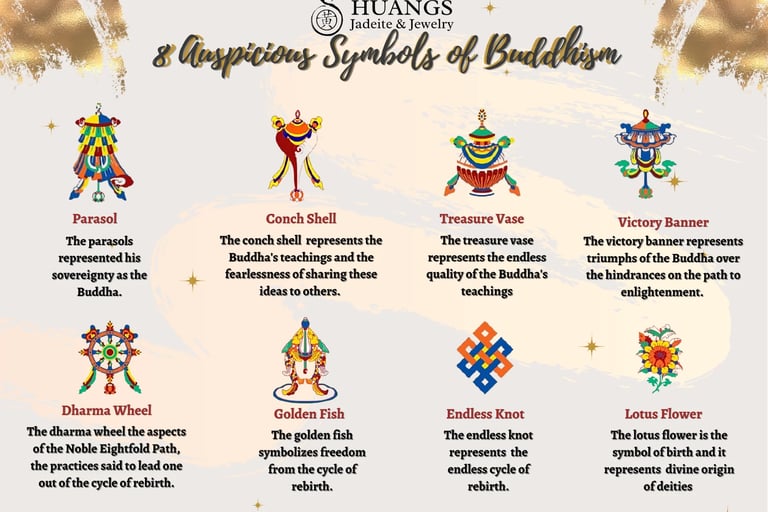
The conch shell is one of the Eight Auspicious Symbols in Buddhism, alongside the Umbrella, Golden Fish, treasure vase, Lotus Flower, Endless Knot, Victory Banner, and the Dharma Wheel. Together, these symbols represent the offerings made by the gods to the Buddha right after he reached enlightenment.
Among these eight good fortune symbols, or "ashtamangala", the Shankha represents the power of the Buddha’s teachings to awaken beings from ignorance and lead them to liberation.
Its spiralling form is also said to symbolize infinity, the endless cycle of birth, death, and rebirth, and the far-reaching sound of the Dharma spreading throughout the universe.
Historical and Ritual Importance
In Buddhist tradition, the conch shell has been used for centuries as a ritual instrument. Monks and practitioners use conch shells to call communities together, announce ceremonies, and mark the beginning of sacred recitations.
The resonant sound produced by blowing a conch is believed to dispel negativity and invite auspiciousness, making it a powerful tool in temple rituals and personal practice.
With so many malas to choose from, if you feel drawn to the shankha ones, I hope this helps make your decision easier.